What's this? A national security official lying to Congress? Thanks to the Internet Archive, repurposed closed-captions, and the Knight Foundation, this sort of blatant abuse of authority becomes public knowledge, disseminated through modern technology.
Friday, June 21, 2013
Government Transparency through Technology


Thursday, May 23, 2013
Minimum Wage Laws and Full Service Stations

Does anyone remember full service stations? A generation or two ago, you were able to drive your car or truck to the service station and when you pulled in, a kid would come out and pump your gas, wash your windows, and maybe even check the fluids and tire pressure. Usually, these were kids with little to no skills that employers valued, so they earned little more than the experience that comes from working, rather like an internship. Jeffrey Tucker even says that we should work for free to gain skills, and I'm inclined to see the reason in the argument. If they earned any wages, they were minimal, but the skills gained helped them gain value over time to employers. These jobs were stepping-stones that those without the means to gain an expensive education could use to work their way to better paying jobs.
Minimum wage laws drove up costs to station operators, and full service stations faded into history. Politicians sought votes, and they promised that those at the low end of the pay scale, even those without skills valued in the market, would be able to "earn" higher wages through these interventionist price controls. Kids without marketable skills took jobs like these and learned basic skills that they could carry into better jobs in the future. They earned very low wages because they offered little skill, and these wage laws have a disproportionate effect of increasing youth unemployment at an even greater rate (are these laws discriminatory?). Minimum wage laws price basic jobs like this out of the market, effectively prohibiting employment below a subjective wage rate, leading to higher unemployment. Minimum wage laws can set minimum wage rates, but have no ability to guarantee employment at a higher, more competitive level where fewer jobs exist.
Today, states like Oregon and New Jersey force gas stations to hire pump attendants, believing that this will lower the unemployment rate. All this does is to reduce the number of these jobs available, since higher input costs lower the opportunity for this type of work. . The more expensive employees become, the fewer of them that employers demand, instead demanding higher productivity out of a smaller workforce. Minimum wage laws, as Murray Rothbard noted, lead to compulsory unemployment.
Tuesday, May 21, 2013
Wage Controls and Unemployment
Walter Block on wage controls from The Case for Discrimination:
"Further, any proposal that artificially raises the salaries of a given calling beyond its productivity level threatens it with unemployment. But equal pay enactments are always couched in terms of raising female incomes, never reducing those of males."
What this means is that when wages for a given service are artificially raised, the demand required for that increased input factor are absent, and the resulting decline in demand due to higher market costs will lead to, among other things, increased unemployment.
It is at times depressing, that so many downtrodden, or simply naively optimistic, still believe that such intervention can have sustainable benefits. The reality is that rent seeking efforts tend to have short shelf lives.
Tuesday, May 7, 2013
Political Ignorance
Politicians think we're idiots. There's not much more to it.
We know how to regulate ourselves for the most part, and we should never discourage that ability as our posterity relies on our ability to persevere through tomorrow. Public officials, government representatives. They say we need them. They say things are better with a ruling class, an oligarchy. Some of the sheeple believe this, thoroughly indoctrinated (cognitively intoxicated on the propaganda).
They think we need them, need to obey them. They make laws, tell us laws keep us from doing bad things. They start telling us everything is bad, that they must help us by regulating everything we do, for our own good, of course. Nevermind that government does not exist. These people have never shared a bed with reason.
If I spend too much relative to what I make, I know eventually it will catch up with me. Never fails. It is self-inflicted. When government does it, how is it any better? Collective ignorance is no less connected to individual ignorance. When government spending outstrips its revenues, coupled with a dollar near the end of it's inflated half-life, leaves us watching and thinking why it hasn't collapsed already?
Saturday, April 20, 2013

Brash Obama Rush to Judgement
Despite no inclination to the motivations of the suspected Boston bombers, Obama seems more than willing to make assumptions and display double standards regarding motivations:
One thing we do know is that whatever hateful agenda drove these men to such heinous acts will not — cannot — prevail. Whatever they thought they could ultimately achieve, they've already failed. They failed because the people of Boston refused to be intimidated. They failed because, as Americans, we refused to be terrorized. They failed because we will not waver from the character and the compassion and the values that define us as a country. Nor will we break the bonds that hold us together as Americans.
Fortunately, while the lamestream media remained silent, witnesses were using technology to remind us why traditional media is nearly irrelevant and dead. Reactions by law enforcement and media were to threaten independent reporters and fire up the spin cycle, twisting the facts to support the official story.
That sounds like great advice. Too bad nobody gave it to the whiny hyper-partisan Barack Obama who had an emotional meltdown in front of the cameras when his push for gun control legislation failed. He certainly didn't have any trouble "jumping to conclusions" and making a "rush to judgment" about the "motivations of the individuals" who opposed him.
Fortunately, supporters of Obama and the anti-rights gun control lobby are relying on ever-declining emotional support. As the facts about gun control become more apparent, just as legitimacy of state (mainstream) media is in decline, the population begins to see that gun control is about control and guns are a sidebar. The debate has little to do with facts, and even poster children like Giffords are less that convincing, since numerous laws were on place that should have prevented her own tragedy if laws actually prevented crime.
No rational argument for gun control is advanced by the likes of Obama or Giffords. Their entire case rests on scurrilous presumptions about the motives of those who oppose them. They deny the very possibility of reasoned disagreement.
Obama's philosophy treats his political enemies far more harshly than the heavily-armed and murderous enemies of the American people.
"Obama's rush to judgment" http://feedly.com/k/10q5wQ4
Monday, February 4, 2013
Obama's Rules for Assassinating American Citizens
This reminds me of the South Park bit, where hunting was prohibited except for self defense, and hunters would yell out "it's coming right at me" before striking out against an innocent victim:
"[t]he 16-page memo, a copy of which was obtained by NBC News, provides new details about the legal reasoning behind one of the Obama administration's most secretive and controversial polices: its dramatically increased use of drone strikes against al-Qaida suspects, including those aimed at American citizens, such as the September 2011 strike in Yemen that killed alleged al-Qaida operatives Anwar al-Awlaki and Samir Khan. Both were U.S. citizens who had never been indicted by the U.S. government nor charged with any crimes."
More:
http://reason.com/blog/2013/02/04/someone-just-leaked-obamas-rules-for-ass Any violation of the nonaggression principle is a moral deficiency, something the Obama regime displays regularly.
Sunday, February 3, 2013
Corn, corn, and more corn
Drinking a Manzanita soda with a Starlite vodka from texas, I can't help but laugh at the fact that, by Michelle Obama's new food standards, my spiked soda is now a vegetable. The Apple-flavored pop is corn-sweetened with high fructose corn syrup and the vodka is yellow corn and wheat distilled seven times.
Rock out with the government intervention...
Thursday, January 3, 2013
Free Market Healthcare and Mutual Insurance

The economic results of government intervention are quite well observed and documented. When the government steps into a market through regulation, it's public "intentions" may be to help increase access to a service, or to drive down costs to make certain goods and services available at costs more affordable to a wider section of the consumers, but those goals often have unintended consequences for which those who study economics can see all too well. The deadweight loss created by intervening in the functions of natural market forces is blatant, difficult to refute or ignore, but when the problems are created by intervention by the state, how can further or expanded intervention reverse that course?

The Cato Institute asked and answered that very question a few years ago, back when the public was thinking that it would be better to plunder our fellow citizens to fund our own health care. Somehow, the idea that theft is bad was shelved for a while, and we were fed that line from the government. Plunder is still immoral, even when we allow someone with guns to do so with our consent. We are still accepting spoils of violence.
It is increasingly obvious that government solutions to health care are not effective. People often find market outcomes appealing. Proponents of free markets in health care should work to make the most persuasive case for real reform and to achieve incremental reforms where possible.
What we need is a true free market in health care and mutual fund insurance, which has historically shown a tendency to drive costs down and accessibility up, something that socialized services fail miserably to do on all counts.

Or we could just stick our heads in the sand and believe that the state will come to our rescue and save us from the big bad capitalists.
Today, we are constantly being told, the United States faces a health care crisis. Medical costs are too high, and health insurance is out of reach of the poor. The cause of this crisis is never made very clear, but the cure is obvious to nearly everybody: government must step in to solve the problem.
In the late 19th and early 20th centuries, one of the primary sources of health care and health insurance for the working poor in Britain, Australia, and the United States was the fraternal society. Fraternal societies (called "friendly societies" in Britain and Australia) were voluntary mutual-aid associations. Their descendants survive among us today in the form of the Shriners, Elks, Masons, and similar organizations, but these no longer play the central role in American life they formerly did. As recently as 1920, over one-quarter of all adult Americans were members of fraternal societies. (The figure was still higher in Britain and Australia.) Fraternal societies were particularly popular among blacks and immigrants. (Indeed, Teddy Roosevelt's famous attack on "hyphenated Americans" was motivated in part by hostility to the immigrants' fraternal societies; he and other Progressives sought to "Americanize" immigrants by making them dependent for support on the democratic state, rather than on their own independent ethnic communities.)
Or maybe government didn't help after all...
House Republicans Celebrate New Year By Allowing Violence Against Women Act To Die
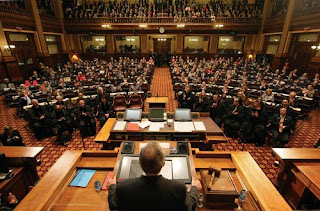
It's all about hownthe media spin the story, not whether it has any merit:
Even after taking heavy losses in the 2012 Election, including a clear rejection by women voters, Republicans still refused to protect women and children.
Isn't it rather redundant that while we already have morality to cover issues of violence and coercion, and that violence general is prohibited (yet not prevented) by the state, further convolution through the law to prohibit specific types of violence already prohibited on the general level is ineffective, but does gain political capital with those intended to benefit from the Law. If the law benefits some disproportionately or at the expense of others (legal plunder), then the law must be abolished, in the words of Bastiat:
But how is this legal plunder to be identified? Quite simply. See if the law takes from some persons what belongs to them, and gives it to other persons to whom it does not belong. See if the law benefits one citizen at the expense of another by doing what the citizen himself cannot do without committing a crime.
Then abolish this law without delay, for it is not only an evil itself, but also it is a fertile source for further evils because it invites reprisals. If such a law — which may be an isolated case — is not abolished immediately, it will spread, multiply, and develop into a system.
Then abolish this law without delay, for it is not only an evil itself, but also it is a fertile source for further evils because it invites reprisals. If such a law — which may be an isolated case — is not abolished immediately, it will spread, multiply, and develop into a system.
In the political theater, opposition tonal which protects or benefits some perceived minority or subset of society is seen through the lens of media as an affront to that subset. This perception of discrimination no less unsubstantiated it than belief in a deity makes it exist. And since "discrimination" is merely the act of making informed choices, we should choose to abandon bad laws in favor of morality and reason. A system of law lacking reason is none on which to base social justice.
As usual, the market will find a natural balance, and those who discriminate against women will find themselves losing the long run. If the law intends to protect women and children, rest assured that it will have the adverse effect of penalizing and oppressing that segment of society.
Tuesday, January 1, 2013
More Fiscal Cliff BS

Krauthammer proves he does not fully understand the debt crisis, and says that the "fiscal cliff" is a "complete surrender on everything," but compromise on such an important economic issue isn't what we need to correct an economic downturn caused by intervention by the state. The disproportionate lack of spending cuts when compared to tax increases only shows the inherent lack of commitment by those in public office. As usual, career politicians have little concern to be accountable for their actions, especially when the tax eaters are living at the expense of the tax producers.
How can anyone seriously thinking about overwhelming debt and spending believe that simply increasing the burden on taxpayers will address the underlying issue; increases in public spending. It's like taking Tylenol for cancer; it doesn't address anything other than a minor symptom. Want to get serious about the national debt and deficit spending? Cut spending by a third, and cut taxes as well.
Texans Against Senator John Cornyn

Anyone else think it's time to see senator Cornyn removed as Texas representative? His recent support for the "fiscal cliff" compromise shows me that he enjoys spending other people's money and would rather see taxes increase so that he can continues to do without regard to that unsustainable path. Cornyn would rather ignore the realistic idea that cutting spending creases deficits, while raising taxes only increases the national debt. How can anyone so ignorant of economic principles be allowed to make fiscal choices on behalf of anyone else? There is nothing bipartisan about what politicians are doing today in regards to responsibility in government, and voting them out is one effective way to make a change in the state.
More:
https://www.facebook.com/pages/Texans-Against-John-Cornyn
At least, with Cornyn and Pelosi holding hands-on this "compromise," we don't have to pass the billet see what's in it...
Sunday, December 30, 2012
Texans Against Senator John Cornyn

Anyone else think it's time to see senator Cornyn removed as Texas representative? His recent support for the "fiscal cliff" compromise shows me that he enjoys spending other people's money and would rather see taxes increase so that he can continues to do without regard to that unsustainable path. Cornyn would rather ignore the realistic idea that cutting spending creases deficits, while raising taxes only increases the national debt. How can anyone so ignorant of economic principles be allowed to make fiscal choices on behalf of anyone else? There is nothing bipartisan about what politicians are doing today in regards to responsibility in government, and voting them out is one effective way to make a change in the state.
More:
https://www.facebook.com/pages/Texans-Against-John-Cornyn
At least, with Cornyn and Pelosi holding hands-on this "compromise," we don't have to pass the billet see what's in it...
Saturday, December 29, 2012
Tuesday, December 11, 2012
Simple Answers to Questions Posed To Imaginary Liberals
I noticed this expansion of the old vastleft strawman while reading deBoer's argument about how all liberals are secret torture apologists:
Here's my problem: for months prior to Election Day, many Democrats and liberals insisted that the position of the presidency was so vastly important that it was worth suspending certain moral and ethical principles in order to elect the better candidate. I don't want to rehash the wrongness or rightness of lesser evilism yet again. I'm just pointing out that this was the argument. And please note that the moral stakes simply could not have been higher; what was in argument were issues of literal life and death, of our stance towards the killing of innocent people. Retaining the presidency was so important that we had to put some of our most basic convictions on hold.
More: Lawyers Guns Money
75 Percent of Obama’s Proposed Tax Hikes to Go Toward New Spending
The Swash calls it for what it is;
Seventy-five percent of the new revenue pulled in by President Barack Obama's "fiscal cliff" plan would go toward new spending, not toward deficit reduction, the Republican side of the Senate Budget Committee contends. Here's a chart, detailing how money from the new tax hikes would be distributed:

I'm not keen to side with one party over the other, but this is just ridiculous. Budgetary debates within government tend to focus on decreases in future spending rate increases, which is hardly cutting back. It's like saying you are not going to spend $100 in the future, only $97. Adjusting future projected spending rates are not the same as cutting spending when we need immediate cuts to keep things from grinding to a halt as a result of career politicians and their partisan politics, not that anything has or will change while either party has their hands around the necks of taxpayers...According to the minority side of the Senate Budget Committee, $1.2 trillion of the proposed $1.6 trillion in tax hikes would go toward new spending, while only $400 billion would go toward deficit reduction.
"The [president's] plan called for $1.6 trillion in new taxes, twice what the president asked for in the campaign. He asked for $800 billion during the campaign. Now he wants $1.6 trillion in new taxes," said Senator Jeff Sessions, the ranking member on the Senate Budget Committee, last week on the floor.
"Spending under that plan would increase $1 trillion above the levels agreed to in the Budget Control Act, as signed into law. We agreed to the Budget Control Act 16 months ago, in August 2011, and we raised the debt ceiling and agreed to reduce spending. We raised the debt ceiling $2.1 trillion and agreed to reduce spending $2.1 trillion. The President's plan would take out over $1.1 trillion of those spending limitations that are in current law. I repeat, spending will increase more than $1 trillion above the already projected growth in spending," Sessions added.
"Our spending is growing. It is not decreasing. It is already projected to grow, but the President's proposal is to have it grow even faster than the law currently calls for."
Boehner says Obama is slow-walking fiscal cliff talks
Cuts, that's funny!
House Speaker John Boehner accused President Barack Obama on Tuesday of slow-walking negotiations to avoid the "fiscal cliff" and urged him to name specific cuts in government spending he would support as part of any compromise.
Monday, December 10, 2012
Handwriting on the wall for Susan Rice
The Benghazi attack gets more convoluted through the political games as time marches on:
Why would the New York Times choose to publish an attack on Susan Rice ("a surprising and unsettling sympathy for Africa's despots") in its Sunday edition? The Times turned over prized op-ed real state to Salem Solomon ("an Eritrean-American journalist who runs Africa Talks, a news and opinion Web site covering Africa and the global African diaspora"), who signaled the UN Ambassador that a nomination to be Secretary of State would not be a bed of roses. Just in case she felt that going on those five Sunday shows and playing a meat puppet mouthing whatever she was told to say about Benghazi deserves some sort of reward.
I see it as a sign that President Obama has decided that confirmation hearings for Rice would be so politically costly that he would be better served by another nominee. Right now, it appears that former Senator Chuck Hagel, a Republican, is being test marketed. Rice is getting the message indirectly that her reward for loyalty is being deferred.
Friday, December 7, 2012
Obama: Give Me Debt Ceiling Power Or I’ll Veto My Own Tax Proposal

In case there is still anyone out there that continues to believe that the 2008 campaign lines that Barack Obama gave about changing the way Washington works, stopping “politics as usual,” and providing more transparency in government are true, then get a load of this. On Wednesday, Obama demonstrated just how partisan and how much of a power grabber he is. He indicated that if he were not given unlimited powers to raise the debt ceiling, apart from Congressional approval, that he might just veto his own tax hike proposal should it come to his desk.
As Obama addressed corporate CEOs at the Business Roundtable, he told them that business leaders “should not accept going through” another debt-ceiling crisis like the one that occurred in 2011, which caused stocks to fall and ended with the first U.S. credit rating downgrade.
He said that the Republicans using the debt ceiling as leverage, in order to get more spending cuts, is not only a “bad strategy for America,” but he was adamant that it was a game he would not play.
Thursday, December 6, 2012
Right-wing Fails to Learn from History and Gives Lead to the Left
In December 2010, I wrote that "An indicator of the incoming House Republican majority's seriousness about cutting spending will be which members the party selects to head the various committees." The final roster ended up leaving a lot to be desired from a limited government perspective. For example, the House Republican leadership and its allies went with "The Prince of Pork" to head up the Appropriations Committee.
Two years later, the committee situation is about to get even worse now that the House Republican leadership has decided to send a message that casting a vote according to one's beliefs instead of one's instructions is a punishable offense. On Monday, four congressmen were booted from "plum" committee assignments for failing to sufficiently tow the leadership line. I suspect that the purge was motivated, at least in part, by Team Boehner's desire to have the rest of the rank and file think twice before casting a "no" vote on whatever lousy deal is struck with the White House to avoid the "fiscal cliff."
Three of the purged Republicans are returning members of the 2010 freshmen "Tea Party Class": Rep. David Schweikert (R-AZ), Justin Amash (R-MI), and Tim Huelskamp (R-KS). Over the past year, I have been keeping a loose record of how the freshmen voted on opportunities to eliminate programs and prevent spending increases. On seven particularly telling votes*, Schweikert and Amash voted in favor of limited government every time. Out of 87 freshmen, only Schweikert, Amash, and five others had a perfect record. Huelskamp was six for seven. He also was one of only four Republicans on the House Agriculture Committee to vote against the bloated farm bill that passed out of the committee in July. The fourth outcast, Rep. Walter Jones (R-NC), had become an irritant to the Republican establishment after turning against the Iraq War and associating himself with more libertarian Republicans like Rep. Ron Paul (R-TX).
More: With Purge, GOP Leadership Reaches New Low
While this looks to be a serious setback for right-wing fascism in the fight to control the state with left-wing socialism, either way we are screwed. Whether one party or the other (or one half of the single party system) gains control of the state is not entirely significant, as individuals in either paradigm are working toward authoritarian systems of government that have been tried and failed throughout history, but why bother learning from history? Or maybe it's more like a horse race, where the winner is fixed before the race begins...
Subscribe to:
Posts (Atom)